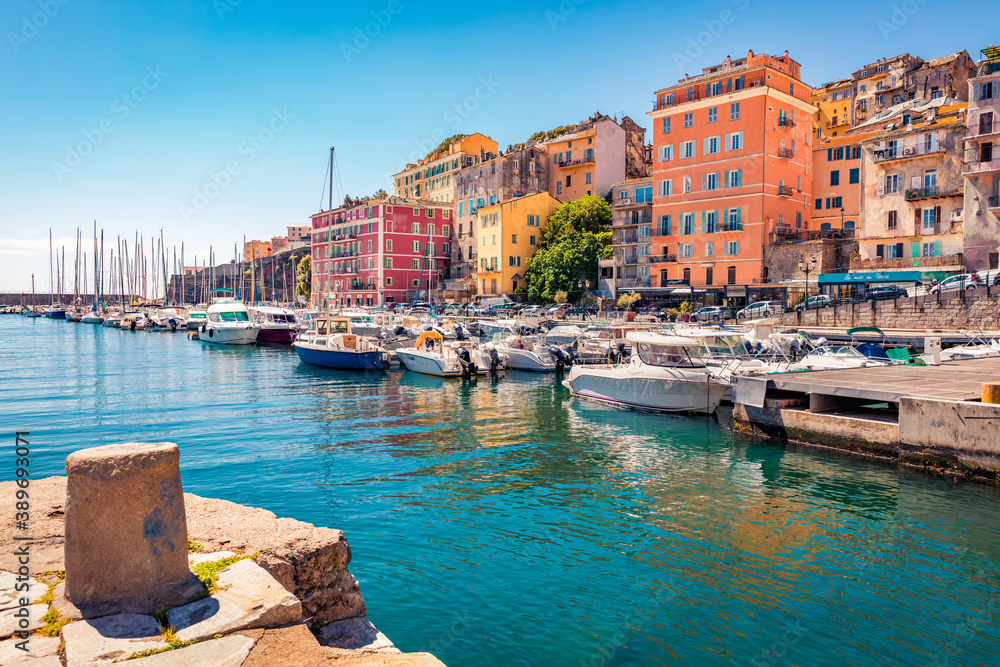
Porto is nothing more than a handful of houses, a tower and a pebble beach at the foot of red rocks. But what a place. It's the gateway to Scandola, the Calanques de Piana and the wildest coastline in the Mediterranean. Small village, immense landscape.
Porto: on the edge of the spectacular
You notice you're approaching Porto by the trees. The road from the interior -- whether you come via the Col de Verghio or the coastal road from Cargese -- descends through a valley full of eucalyptus trees that fill the air with their scent. It's a peculiar welcome: the trees aren't native, once planted and since gone wild, but they've become part of the experience. When you catch that eucalyptus aroma with the windows down, you know you're almost there.
Porto itself is small. Truly small. There's an upper village along the main road, a lower village by the river and a little further on the marine -- the small bay with the beach and the harbour. All told, the village has perhaps five hundred residents, and fewer still in winter. It's not a destination in itself in the traditional sense; it's a base camp, an anchor point, a place to return to in the evening after a day that's left you open-mouthed.
But what a base camp.
The Genoese tower at sunset
The first thing you see on arrival is the Tour de Porto, a Genoese watchtower standing prominently on the rock above the bay. There are dozens of towers like it along the Corsican coast, built in the sixteenth century to signal pirates, but this one is among the best preserved and most photogenic.
Head there towards the end of the afternoon. The tower can be visited -- a few euros entry, a narrow staircase to the top -- and the view from up there is worth it. But the real moment comes when you're back outside, on the rocks beside it, and the sun drops behind the mountains. The light turns the red rocks of the bay into shades that no photograph can do justice. Orange, pink, deep red -- it changes every minute.
Insider tip Bring something to drink and a piece of cheese to the rocks by the tower. There's no terrace, no bar, nothing commercial -- just you and the view. Sunset in Porto is one of the unforgettable moments of Corsica.
The beach and the river
Porto's beach is not a sandy beach. It's a pebble beach of large, round stones, dark grey and reddish-brown, wedged between towering rock walls. It's spectacular to look at, less comfortable to lie on. Bring a mat or a thick towel, and water shoes for walking over the stones.
The water is deep and clear. Swimming here feels like swimming in a natural amphitheatre, with the cliffs as the grandstand. Snorkelling is surprisingly good -- the underwater rocks are covered with marine life and the visibility is excellent.
Behind the beach flows the Porto river, where you can swim in natural pools during summer. A fifteen-minute walk upstream brings you to spots where the water is deep enough to dive into, surrounded by rocks and maquis. It's a welcome change after the salty sea.
Boat trips: Scandola, Girolata and the Calanques
The main reason to stay overnight in Porto is its proximity to three of the most extraordinary places in Corsica, all reachable by boat from the small harbour.
The Reserve Naturel de Scandola is a UNESCO World Heritage site that can only be reached by water. Red and orange rock cliffs rise hundreds of metres from the sea, pierced with caves and home to ospreys and seabirds. The water below is so clear you can see the bottom at ten metres. A boat trip to Scandola takes half a day and is, without exaggeration, one of the most impressive natural experiences you can have in Europe.
Girolata is a hamlet reachable only by boat or on foot -- there's no road to it. A handful of houses, a fort, a few restaurants and a beach. The boat trips to Scandola usually stop here for lunch. It feels like the end of the world, and in a way it is.
The Calanques de Piana lie south of Porto: red granite rock formations sculpted by erosion into towers, arches and figures. From the road (the D81 towards Piana) they're already spectacular, but from the water they're breathtaking. Boat trips from Porto often combine Scandola and the Calanques in a day trip.
Insider tip Book your boat trip a day in advance, especially in July and August. The smaller boats (maximum twelve passengers) are more expensive but infinitely better than the large excursion vessels. You get closer to the rocks, the skipper stops wherever it's beautiful and you can swim in places the big boats can't reach.
Eating in Porto
For such a small village, you eat surprisingly well in Porto, though the choice is limited. Le Soleil Couchant by the marine has a terrace overlooking the tower and serves solid Corsican cuisine -- the soupe de poisson is a must if it's on the menu. In the upper village you'll find a couple of pizzerias and a creperie that's better than you'd expect.
The supermarket in the upper village is small but has the essentials. For a proper shop you'll need to go to Cargese or Evisa. In Porto, focus on local products: chestnut beer from the mountains, wild fig jam and the charcuterie from the maquis pigs you've been passing on the road.
Porto as a base
Porto's location makes it ideal as a base for three or four days on the west coast. From here you can drive to the Calanques de Piana in half an hour, to the walking area around Evisa and the Spelunca gorge in forty-five minutes, and the boat trips to Scandola leave from the harbour. The Col de la Croix heading north offers one of the finest panoramas on the island.
Accommodation in Porto is modest but sufficient. There are a few hotels, some apartments and a campsite. It's not a luxury destination, and that's exactly its charm. You're not here for the village -- you're here for everything around it.
The feel of Porto
There's a moment in Porto that sums it all up. You're sitting on the rocks by the tower, the sun has just set, the light is blue-purple and the sea below you is almost black. The mountains behind you are silhouettes. There's no sound except the water. And you realise how small you are in this landscape -- how overwhelmingly vast and ancient and indifferently beautiful the west coast of Corsica is.
Porto is not the place for those seeking entertainment, shops or a buzzing nightlife. It's the place for those who want to be stopped in their tracks. And that it does, every single evening.