Traffic and Safety in Corsica
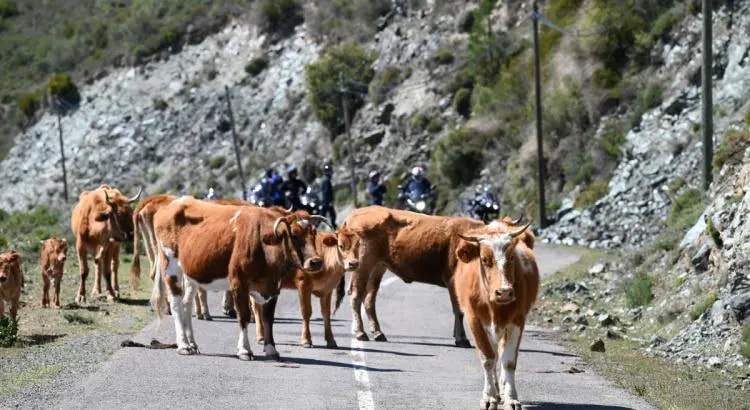
Summary: Corsica is a fantastic island to explore by car, motorcycle, or campervan, but the traffic demands your attention. Narrow mountain roads, sharp bends, free-roaming livestock, and summer crowds can make driving challenging at times. With a little preparation and the right pace, however, you'll drive safely and enjoyably.
Corsica was made to be explored. Driving through mountains, along clifftops, and through tiny villages, you'll discover the island at its finest. At the same time, it's worth knowing that driving in Corsica is different from driving on the mainland. Not difficult, but something to be aware of.
The Roads: Stunning but Sometimes Treacherous
The road network consists of territorial roads (T-roads), departmental roads (D-roads), and plenty of smaller mountain roads. The latter are often narrow and winding.
Keep in mind:
- Narrow roads, sometimes without guardrails
- Hairpin bends with limited visibility
- Major changes in elevation
- Free-roaming livestock (cows, goats, and even pigs)
- Poor or uneven road surfaces
You rarely drive fast in Corsica. Distances may look short on the map, but often take more time than you'd expect. Here, people measure journeys in hours, not kilometres.
Insider tip Never plan too tightly. A 50-kilometre drive can easily take an hour and a half, especially in the mountains or during peak season.
Typically Corsican Traffic
On the road, you'll encounter all sorts:
- Slow-moving locals in pick-up trucks or tractors
- Delivery drivers who seem to be in a remarkable hurry
- Scooters and motorcycles overtaking where you least expect it
- Tourists who suddenly stop for a photo
- Animals crossing without warning
Honking on blind corners is perfectly normal and considered cautious driving. On narrow roads, the rule is: whoever has space, makes space. And if someone faster is behind you? Pulling over briefly is always appreciated.
Traffic Rules and Driving Etiquette
French traffic rules apply in Corsica. Here are the key points:
Speed Limits
- Built-up areas: 50 km/h
- Outside built-up areas: 80 km/h (sometimes 90 km/h, depending on signage)
- Dual carriageways: 110 km/h
- In rain, lower limits apply automatically
- Newly qualified drivers have lower maximum speeds
Seatbelts and Child Seats
- Seatbelts are compulsory for everyone, front and back
- Children under 10 must use an approved child seat or booster
- Children under 10 are not allowed in the front seat, unless there is no rear seat
Phone Use and Distractions
- Hands-free calling is only permitted via a built-in system
- Earbuds, headphones, and loose phone holders are prohibited
- While driving, it is forbidden to:
- eat or drink
- smoke
- apply make-up
- drive in unsafe footwear (such as flip-flops)
Violations fall under dangerous driving and can result in hefty fines, especially in the event of an accident.
Dashcams
Dashcams are permitted, provided they don't obstruct the driver's view. Footage may not be shared online without consent. In the event of an accident, however, it can serve as evidence.
Toll Roads
There are no toll roads on Corsica itself. All roads are free to use. If you're driving through mainland France to reach Corsica, you will encounter toll roads there.
Traffic Checks and Police
During peak season, there are frequent checks, particularly for:
- Speed
- Alcohol
- Validity of documents
- General driving behaviour
You may be stopped by the gendarmerie, CRS, or police. Always have the following with you:
- Driving licence
- Vehicle registration document
- Insurance certificate
- ID document
Insider tip Checks are usually polite and straightforward. Stay courteous and calm — it's almost always received positively.
Breakdown or Accident: What to Do
In Case of a Breakdown
- Pull over as safely as possible
- Put on your high-visibility vest
- Place a warning triangle (at least 30 metres behind your vehicle)
- Call your hire company or breakdown assistance through your insurance
In Case of an Accident
- Call the European emergency number 112
- Stay calm and provide assistance where possible
- Wait for emergency services such as police, fire brigade, or ambulance
Extra Caution in Summer
Summer brings additional risks:
- Busy beaches lead to congested roads and parking chaos
- Many inexperienced drivers (campervans, motorcycles)
- Heat causes loss of concentration and mechanical problems
- Animals seek shade on the tarmac
During this period, there are also more police checks than usual.
Safe Driving = Relaxed Holiday
Corsica is not an island to rush through. Take your time, plan rest stops, and accept that sometimes you'll have to wait. That patience will be rewarded with spectacular views, quiet mountain roads, and unexpected encounters with animals in the middle of the road.
Practical Tips
- Fill up on fuel in good time, especially in mountainous areas
- Watch for signage in Corsican language
- Always carry water on longer drives
- Avoid driving at night if you don't know the road
- Take extra care if you're cycling: Corsicans are not accustomed to cyclists
Emergency Numbers in Corsica
In an emergency, always be prepared to state:
- Who you are (phone number)
- Where you are (as precisely as possible)
- What has happened
Important numbers:
- 112 - European emergency number
- 17 - Police
- 18 - Fire brigade
- 15 - SAMU (medical emergencies)
- 114 - For deaf and hard of hearing
Save these numbers in your phone. It gives peace of mind, even if you never need them.