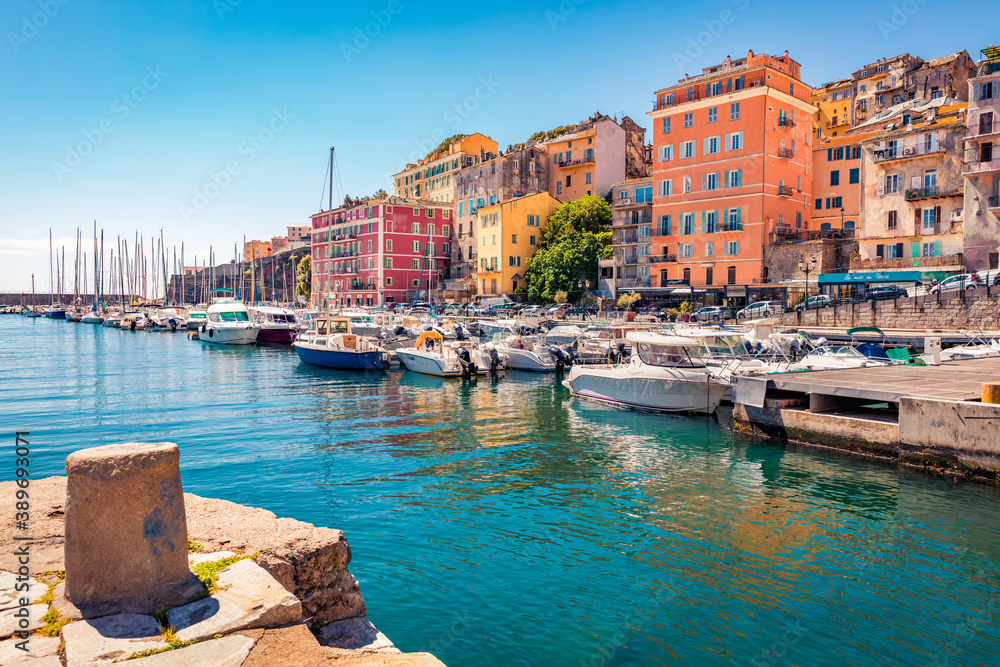
L'Ile-Rousse is the more relaxed counterpart to Calvi: a compact coastal town with a lively market, a town beach within walking distance of everything, and a laid-back atmosphere that feels more Provencal than Corsican. It's the kind of place where you arrive after a day of driving through the mountains and think: I can settle in here.
L'Ile-Rousse: the market town of the Balagne
The name says it all: the red island. L'Ile de la Pietra, the small rocky islet of reddish-brown porphyry connected to the town by a causeway, gives L'Ile-Rousse both its name and its face. Walk along the causeway to the lighthouse, preferably around sunset, and you'll immediately understand why. The rocks glow deep orange-red against the blue water -- one of those moments you know you're going to remember.
The town itself was founded by Pasquale Paoli in 1758, as a counterweight to Genoese-controlled Calvi. Paoli wanted his own port for independent Corsica, and that strategic origin is still evident in the neat, grid-like layout of the centre. No winding medieval alleyways here, but an orderly grid of streets around a central square.
And that square is the heart of everything. Place Paoli is a broad, plane tree-lined square where social life plays out. There's a statue of Paoli himself -- defiant, arm raised -- and all around people sit on terraces, children play and in the evenings petanque is sometimes played. It's a square where you can settle in at any time of day.
Insider tip The covered market on Place Paoli is open every morning. Don't walk past it. The cheese stall at the back has brousse (fresh sheep's cheese) that you won't find this good anywhere else. Pair it with some Corsican ham and a piece of bread, and you've got a perfect breakfast to take to the beach.
The beach in the centre
What sets L'Ile-Rousse apart from many other Corsican coastal towns is the location of its beach. Plage de la Marinella starts literally at the edge of the centre. Walk five minutes from the market square and your feet are in the sand. The beach is wide enough, the water is clear and shallow, and there are plenty of facilities without it feeling over-organised.
In high season it gets busy, naturally. But walk a stretch eastward, towards Plage de Caruchettu or further to Plage de Bodri, and it quickly becomes quieter. The latter you can also reach by the Tramway de la Balagne -- get off at the Bodri stop and walk a few minutes downhill. One of the nicer beach discoveries you can make this way.
On the other side, towards the Ile de la Pietra, you find smaller rocky coves. Less suited for a full day at the beach, but perfect for a quick swim in between. The water is deeper here and the snorkelling surprisingly good for being so close to town.
Strolling and eating
The centre is compact and you can walk through it in half an hour. But the charm lies precisely in taking it slow: an espresso at A Siesta on the square, a wander through the market stalls, an ice cream from Glacier de la Place. The shops are a mix of touristy and local. Seek out the delicatessens for Corsican specialities: lonzu, coppa, brocciu, fig or chestnut jams.
Restaurant-wise, L'Ile-Rousse has a good selection without the prices of Calvi or Porto-Vecchio. A Quadrera serves honest Corsican dishes in a quiet garden -- their veau aux olives is a must-try. Along the harbour you'll find fish restaurants where the catch of the day ends up on your plate. Quality varies, as it does everywhere on the coast, but if you choose the terraces with handwritten menus over the ones with plastic laminated photo cards, you'll usually do well.
Insider tip Thursday is market day with extra stalls outside the covered hall. That's when you also find clothing, soap, honey and local wines. It's busier but more atmospheric than the regular morning market.
The Tramway de la Balagne
One of the best things to do from L'Ile-Rousse is the Tramway de la Balagne: a narrow-gauge train that runs along the coast to Calvi. It's no luxury railway -- think of a diesel rattler on rails -- but the route is gorgeous. The train stops at small halts alongside remote beaches. You can make a day of it: take the morning train to Calvi, explore the citadel and harbour there, and head back on a later train via a beach stop.
The train runs from April to October, several times a day. A single ticket costs just a few euros. It's both a practical means of transport and an experience in itself.
Calvi or L'Ile-Rousse?
The question always comes up: Calvi or L'Ile-Rousse? The honest answer: they're complementary. Calvi has the citadel, the longer beach and more nightlife. L'Ile-Rousse is smaller, friendlier and feels less touristy. If you're after peace and authenticity, choose L'Ile-Rousse. If you want more buzz and a more imposing backdrop, Calvi is your spot.
Many people combine both. By car it's half an hour, by train 45 minutes. They're not competitors but neighbours with their own personality.
Practical info
L'Ile-Rousse has a ferry port with connections to Nice and Marseille (Corsica Ferries and La Meridionale). That makes it a handy arrival point if you're coming with a car. Parking in the centre is a challenge in high season -- drive on to the car park near the station or on the edge of town. Outside July-August it's no problem.
The town has a small train station with connections to Calvi and Ponte Leccia (and from there to Bastia or Ajaccio). It's not the fastest way to travel, but it's charming and you avoid the winding mountain roads.
L'Ile-Rousse is a place that doesn't overwhelm you but that slowly grows on you. After a day or two you know the baker, the cheese lady at the market and the terrace where you like sitting best. And then you don't really want to leave.