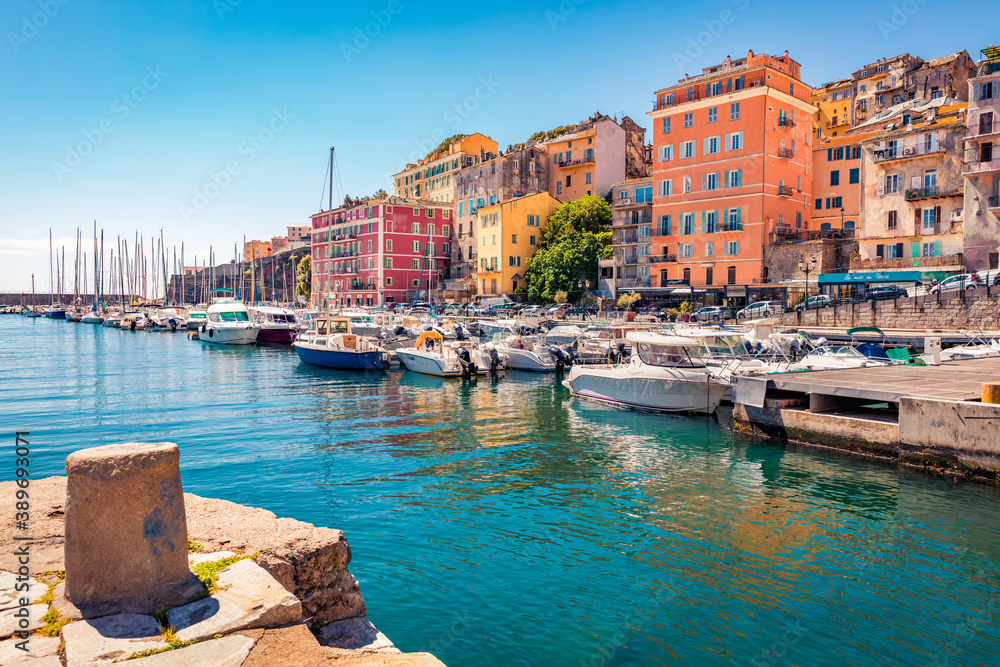
Aleria is one of the oldest inhabited places on Corsica, yet almost nobody has it on their list. That's a shame, because behind this sleepy little town on the east coast lies a history stretching back to the Greeks and Romans, a surprisingly good museum, the island's largest wine region, and a lagoon where you eat the best oysters on Corsica.
Aleria: two thousand years of history on the flat coast
Most visitors to Corsica drive straight through Aleria on the N198 without stopping. The town sits on the east coast, at the spot where the Tavignano river meets the sea, and at first glance doesn't look like much. A few streets, a handful of shops, a traffic light. But anyone who drives up the hill to the Fort de Matra discovers a very different story.
From Greek colony to Roman capital
Aleria is one of the oldest settlements in the western Mediterranean. In 565 BC Greek colonists from Phocaea founded the city of Alalia here. They chose this location for its sheltered position at the river delta and the fertile land surrounding it. The Greeks were later driven out by the Etruscans and Carthaginians, after which the Romans took over in 259 BC and turned it into the capital of their province of Corsica.
Under Roman rule Aleria grew into a city of significance, with a forum, thermal baths, an amphitheatre and a harbour connecting the island to the mainland. It was the economic and administrative centre of Corsica for centuries. It only lost that position when malaria and invasions slowly emptied the city during the Middle Ages.
Insider tip Combine the museum and the excavations in a single visit of an hour and a half to two hours. Start in the museum for context, then walk to the ruins behind it. The entry ticket covers both.
The Musee Jerome Carcopino
The Musee Departemental Jerome Carcopino is housed in the Fort de Matra, a fifteenth-century Genoese fort that towers above the town. The collection is compact but impressive. You'll find Greek vases, Etruscan bronzes, Roman glassware and jewellery unearthed during excavations. It paints a picture of a trading city connected to the entire Mediterranean.
The most striking piece is a rhyton -- a drinking horn in the shape of a dog's head -- from the fifth century BC, one of the finest Greek artefacts ever found on Corsica. The collection isn't large, but the quality is high and the presentation clear. You can get through it in an hour, but it shifts your perspective on Corsica: this island wasn't always the periphery it may seem today.
Behind the fort lie the Roman excavations: the foundations of the forum, remains of dwellings and a partially uncovered bathhouse. It's no Pompeii, but with a little imagination you can picture how the town must have functioned two thousand years ago. The hilltop location, with views over the plain and the sea, makes it clear why the Romans chose precisely this spot.
The wine region
Around Aleria stretches Corsica's largest wine region. The Plaine Orientale produces more than half of all Corsican wine, and while its reputation was long one of bulk production, today there are estates making excellent wines.
A few names to look out for: Domaine Mavela uses organic methods and makes a good muscat among other wines. Clos de l'Alzeto lies a bit further inland and is one of the highest-elevation vineyards on the island. Many estates sit along the N198 or its side roads and offer free tastings. It's low-key: you drive onto the grounds, taste three or four wines, buy a bottle if you like what you taste, and drive on.
The grape varieties are partly uniquely Corsican. Nielluccio (related to the Italian sangiovese) produces sturdy red wines, sciaccarello is lighter and spicier, and vermentino is the white grape you encounter everywhere on the island. At the estates around Aleria you often taste blends of these varieties, and the prices are considerably lower than at the better-known appellations like Patrimonio.
Insider tip Ask for the rose at wine tastings -- that's what the Corsicans themselves drink most, and the roses from the east coast are surprisingly good and incredibly affordable. A bottle for five to eight euros is normal here.
Etang de Diane
North of Aleria lies the Etang de Diane, a shallow brackish-water lagoon that has been known for its shellfish since Roman times. Oysters and mussels are farmed here in the salty, nutrient-rich water, and at a couple of oyster farms on the edge of the lagoon you can eat them right on the spot.
The best known is Chez Jacky, a simple restaurant on stilts above the water. You get a plate of oysters, a bowl of mussels, bread and a carafe of white wine, all while looking out over the still lagoon. It's simple, fresh and exactly right. In high season booking ahead is wise, but in May, June or September you can often just turn up.
The lagoon itself is also interesting for birdwatchers. Grey herons, cormorants and occasionally flamingos can be seen here, especially in spring and autumn when migratory birds cross the Mediterranean.
Beaches near Aleria
The beaches near Aleria lie a few kilometres east of the town. Plage de Padulone is the most accessible: a broad, long sandy beach with shallow water, a few beach bars and plenty of parking. It's not spectacular, but it's clean, quiet and practical. For families with children it's ideal.
Further south there are more secluded beaches reachable via unpaved roads. Plage de Pinia is surrounded by pine forest and feels considerably wilder. There are no facilities, so bring your own water and parasol.
Insider tip Make Aleria a stopover on your way from Bastia to Porto-Vecchio or Bonifacio. With two hours for the museum and ruins, an hour for oysters at the Etang de Diane and a late afternoon on the beach, you've got a full, varied day.
Why stop in Aleria
Aleria will never compete with the drama of Bonifacio or the beauty of Porto. But it offers something those places don't: the combination of serious history, honest food and a relaxed atmosphere without any tourist circus. It's a place that stays with you not because of a spectacular view, but because of a plate of oysters by the water, a Greek vase in a cool museum, and the realisation that this sleepy little town was once the most important city on the island.
For anyone exploring the east coast of Corsica, a stop in Aleria isn't a detour but an enrichment. And for those simply passing through on the N198: take that exit. It's worth it.