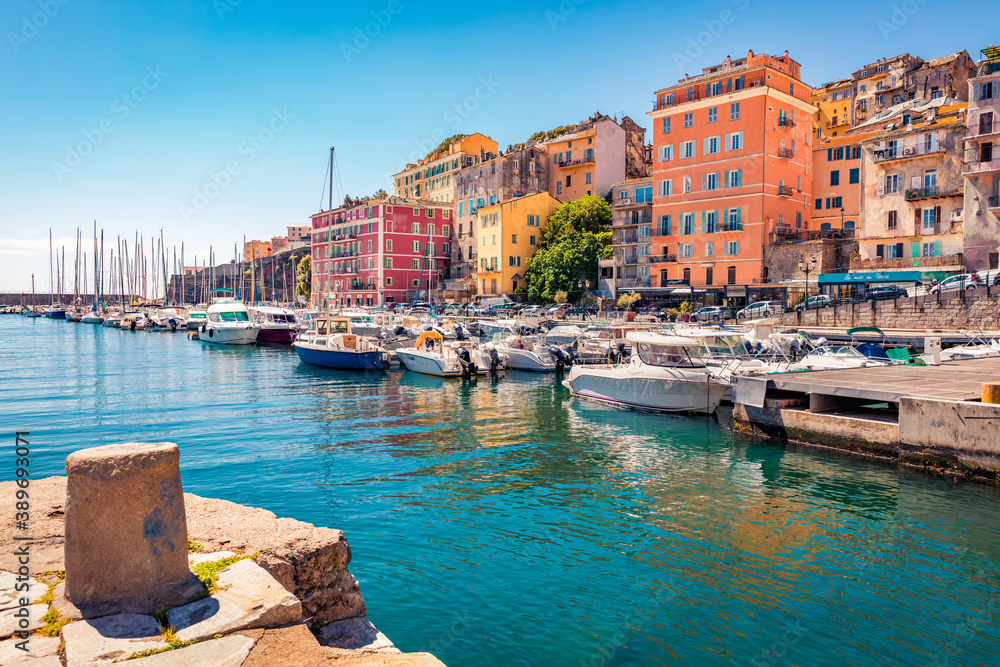
Bonifacio is a town you won't quickly forget. Built on the edge of white limestone cliffs, with a medieval upper town and a lively harbour below, it's arguably the most spectacular place in all of Corsica. And that's saying something on an island that's hardly short of impressive spots.
Bonifacio: on the edge of the island
The first time you approach Bonifacio, it makes an impression. Coming from the south you drive through a dry, almost barren landscape of low maquis and wind-bent trees. Then the road opens up and you see the town: a strip of medieval houses that seem to lean over the edge of a cliff, tens of metres above a narrow strait. To the right the Mediterranean glitters, to the left a sheltered harbour full of boats. It feels surreal.
The town consists of two parts, both of which you'll want to see. Down below is the harbour, the Marine, with restaurants, ice-cream parlours, dive schools and boat rental companies. It's lively and sometimes busy, but the vibe is relaxed. Up on the cliff is the haute ville, the old town, walled and compact. Between the two runs the Montee du Rastello, a steep stairway that's also accessible by car, or you can take the small tourist trains.
Insider tip Walk the stairs up rather than taking the car. It's steep but short, and halfway up you already have views over the harbour and the sea. Besides, parking in the haute ville is limited and expensive in season.
The old town on top is a maze of narrow alleyways, flights of steps and tall houses built close together. It feels Italian, which makes sense: Bonifacio was under Genoese influence for centuries and the local language sounds more Ligurian than French. Walk along the Rue des Deux Empereurs, where both Napoleon and Charles V once stayed, and emerge at the Eglise Sainte-Marie-Majeure, a Romanesque church from the 12th century with a loggia where the town council once met.
The absolute highlight is the view from the cliffs on the southern side. Via a path along the edge you reach the Escalier du Roi d'Aragon, a staircase of 187 steps carved diagonally into the rock face. According to legend the Aragonese besiegers had this stairway hewn in a single night, which sounds implausible even for the most motivated stonemason. What is true: the staircase is spectacular. You descend along a steep rock wall with the sea at your feet. Admission is a few euros and it's more than worth it.
Insider tip The Escalier du Roi d'Aragon is only open from April to October. Go preferably early in the morning, before the heat and the crowds. Wear sturdy shoes, as the steps are uneven and sometimes slippery.
From the harbour, boats depart for the Bouches de Bonifacio, the strait between Corsica and Sardinia. The standard trip takes about an hour and sails along the cliffs, letting you see the top of the town from the water. You pass caves, natural arches and the famous Grain de Sable, a free-standing rock formation that looks like an enormous boulder sitting in the sea. Longer trips go to the Lavezzi islands, a protected nature reserve halfway to Sardinia. The water there is crystal clear and the rocks resemble a moonscape. In high season there are quite a few boats around, but it's still gorgeous.
A spot that most tourists miss is the Cimetiere Marin, the sailors' cemetery on top of the cliffs west of the old town. Here white tomb monuments and mausoleums stand scattered across a plateau overlooking the sea. It's a quiet, striking place that contrasts with the bustle in the harbour below.
On the practical side: parking in Bonifacio is a challenge in high season. The car parks by the harbour are paid and fill up fast. There are larger parking areas on the outskirts of town, from where you can walk or take a shuttle bus. It's wise to arrive early or in the late afternoon, when the day trippers are leaving.
Insider tip Stay until after sunset. Most visitors leave around 6 pm, and after that Bonifacio becomes much quieter. Dine in the haute ville at one of the smaller restaurants tucked away in the alleyways. The food is often better and cheaper than at the harbour.
Dining in Bonifacio is generally good but not cheap. The harbour restaurants charge tourist prices, especially for fish. In the haute ville you'll find more local spots. Try the aubergines a la bonifacienne, a local dish of stuffed aubergines, or simply order a plate of charcuterie with Corsican sausage and cheese alongside a glass of Figari wine from the area.
Bonifacio feels different from the rest of Corsica. It's more worldly, more Italian, more oriented towards the water. It's also undeniably touristy, but the setting is so unique that it hardly matters. There is simply no other place on the island, or in the entire western Mediterranean, that resembles it.